
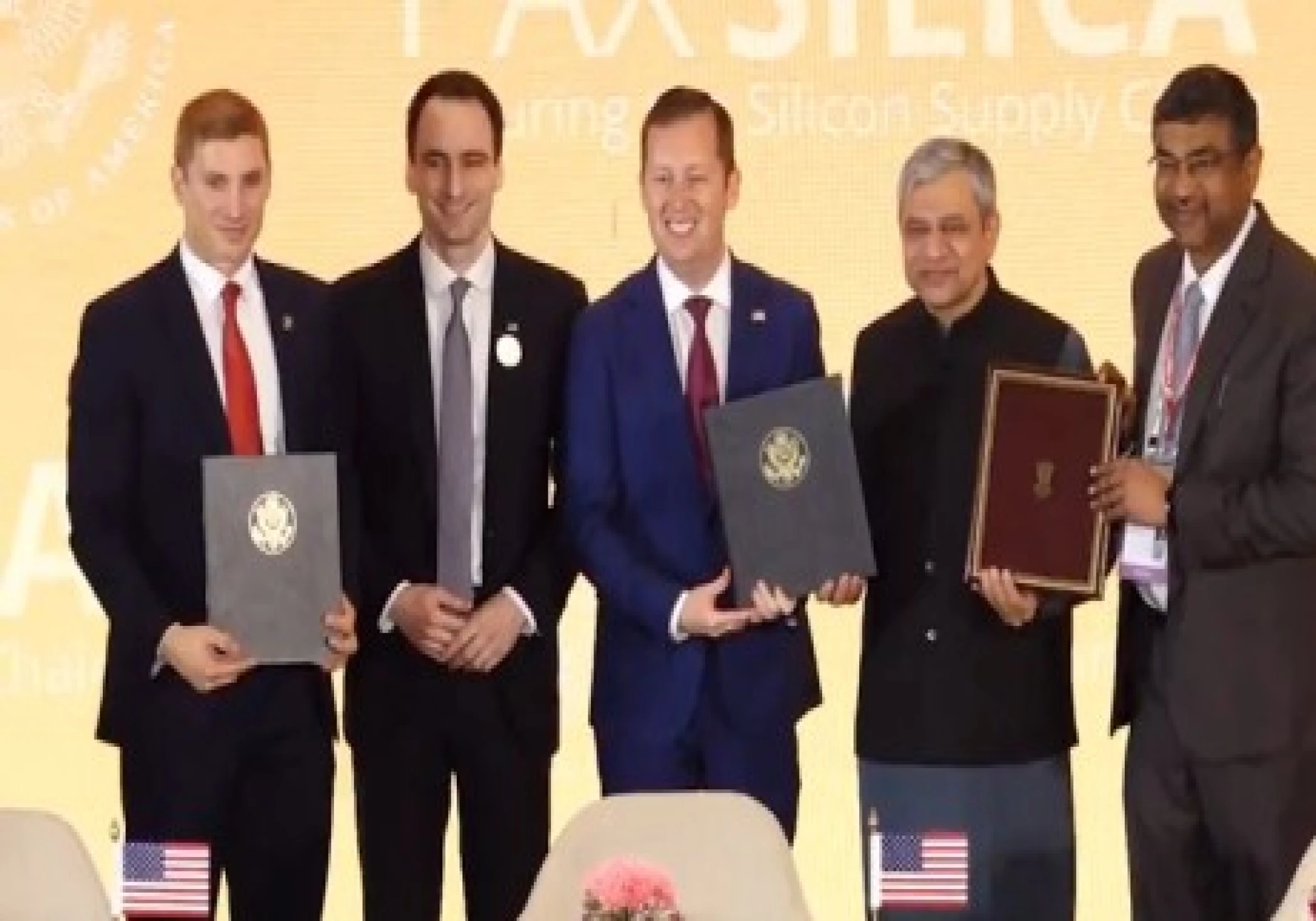
India has signed up to formally join the US-led Pax Silica Alliance. This move is a step towards the development of artificial intelligence and rare earth... Read More
After removing the ongoing confusion about the trade deal, there is a new confidence in the relations between India and the United States. New Delhi: India on Friday signed an agreement to formally join the US-led Pax Silica Alliance.
This step is considered to be a major step towards creating a safe, robust and reliable supply chain of Artificial Intelligence (AI) and rare earth minerals. So far, the whole world is dependent on China in the supply, refining and mining of rare minerals.
What is Pax Silica?
In such a situation, Pax Silica is a new campaign launched internationally under the leadership of the US so that there is no dependence on China. It has countries like Australia, Greece, Israel, Japan, Qatar, South Korea, Singapore, United Arab Emirates and the United Kingdom as members.
Agreement signed at AI Impact Summit 2026
Electronics and Information Technology Minister Ashwini Vaishnaw did the work while US Ambassador Sergio Gore and US Under Secretary of State for Economic Affairs Jacob Helberg were also present at the ceremony. US Under Secretary of State Jacob Helberg described India's cooperation as a defining step in the economic and technological order of the 21st century.
The alliance focuses on deeper economic and technological cooperation across the entire supply chain, from critical minerals to semiconductors and AI infrastructure. It aims to ensure mutual prosperity, security, and AI-led development.
India joins PAX Silica
India's accession to the alliance has given a new momentum to the relations between the two countries, especially after the tense situation of some time in the past. India's accession to PAX Silica is believed to be linked to efforts to finalize the proposed trade agreement and other bilateral cooperation further.
Speaking on the occasion, Vaishnaw said, "India has become a part of Pax Silica. This will greatly benefit India's electronics and semiconductor industry. Already in India








_500_x_350.webp "PEC expresses concern over suspicious journo-deaths")