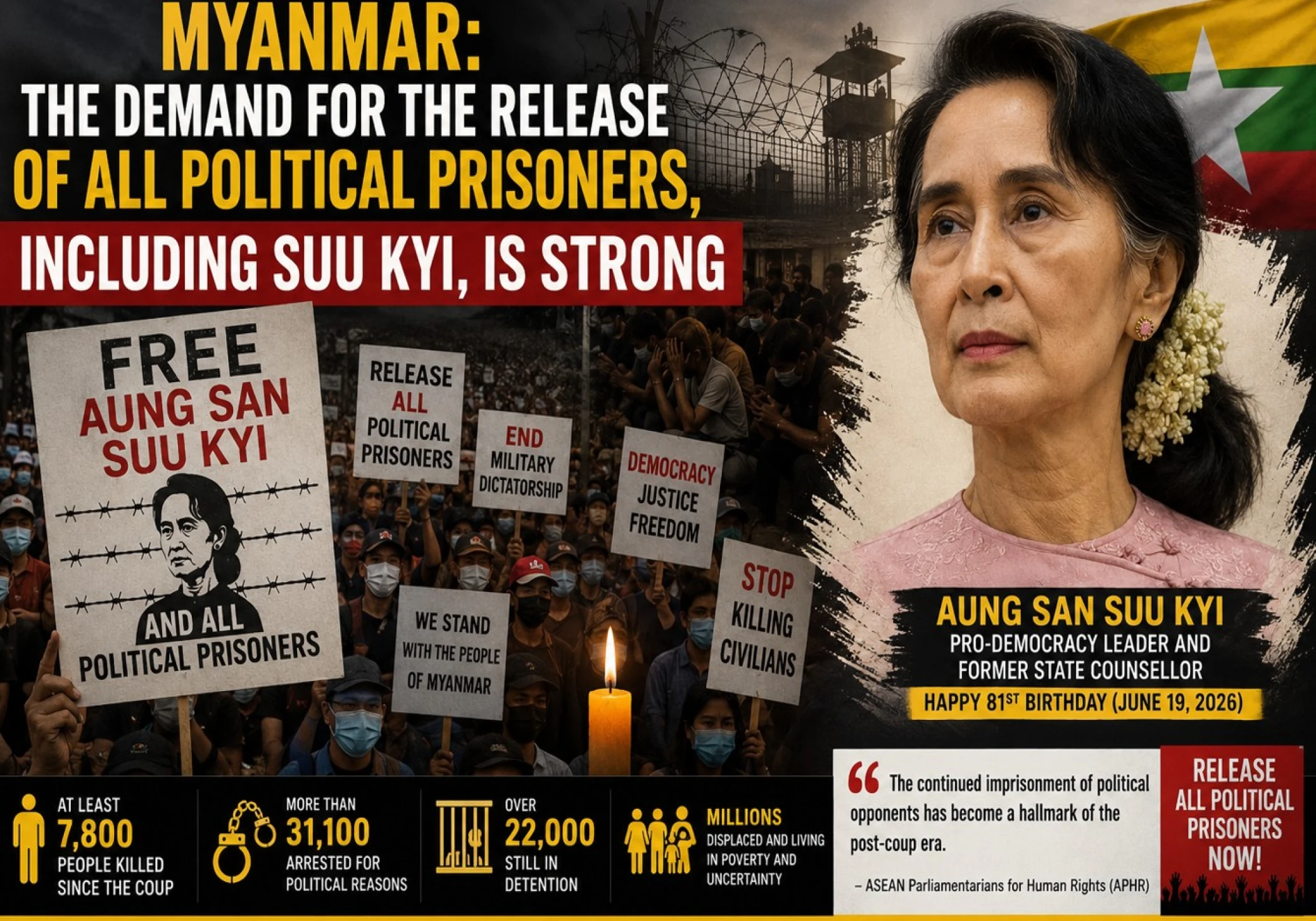
When pro-democracy leader Aung San Suu Kyi celebrated her 81st birthday on June 19, 2026, there was an international demand for the immediate release of her and thousands of other political prisoners in various prisons in the Southeast Asian country. UN officials, parliamentarians, human rights organizations, diplomats, democracy activists and Myanmar citizens living inside and outside the country observed this day as an opportunity to express serious concern over their health and the ongoing socio-political crisis in the country struggling with poverty.
At the global level, people emphasized the need to reduce violence against civilians and support inclusive political dialogue to resolve the crisis. The Buddhist-majority country with a population of around 5.5 crore has been facing a crisis since the military coup five years ago. When this great woman celebrated this special day at an undisclosed location in Myanmar's new capital, Nay Pyi Taw, anti-junta activists marked the day with symbolic rallies and messages of solidarity. He reiterated that Nobel Peace Prize laureate Suu Kyi remains a powerful symbol of democratic aspirations in Myanmar. The last military coup in Myanmar was on 1 February 2021, by the then top military commander (who later became the civilian head of state).
The collective appeal came from a forum of parliamentarians of the Association of Southeast Asian Nations member states, demanding the immediate release of Suu Kyi and all other political prisoners. ASEAN Parliamentarians for Human Rights (APHR) is supported by 134 current and former parliamentarians from Australia, Cambodia, Indonesia, Italy, Malaysia, Singapore, South Africa, Thailand, Timor-Leste and the Philippines. They also demanded independent access to check on their health and well-being.
In an open letter to ASEAN 2026 Chairman Ferdinand Marcos Jr. (President of the Philippines) and its member states, he argued that the Southeast Asian Forum's credibility as a regional body committed to peace, stability and democratic principles would be strengthened when it made practical efforts to resolve the persistent crisis faced by one of its member states (Myanmar).
Since the coup led by military leader Min Aung Hlaing (who is now the country's president), at least 7,800 people have been killed, including pro-democracy activists and civilians. More than 31,100 people were arrested for political reasons, of which more than 22,000 people are still in custody. Millions of people have become homeless, and they are living in makeshift camps amidst abject poverty and uncertainty. The letter also drew attention to the continuing reports of torture, ill-treatment, lack of treatment and other forms of ill-treatment in detention centers. It states that the continued imprisonment of political opponents has become a hallmark of the post-coup era.
The main topic of international concern is the uncertainty surrounding Suu Kyi's health. Suu Kyi, who has been detained since the day of the coup, has spent most of her time cut off from the outside world. In April 2026, there were reports that he was removed from jail and placed under house arrest somewhere in the capital. Neither their family members nor their legal representatives nor any independent observer has been allowed to meet them to verify these claims. In the absence of independent confirmation, the demand for proof of their existence is gaining momentum. MPs finally pressed for reliable information about their health and for them to get the treatment they need.
The issue has gained further prominence from a campaign launched by Suu Kyi's son Kim Aris (who is a British citizen). He has appealed to the governments and international organizations to confirm that his mother is alive and getting proper treatment. Aris said that his mother has celebrated her sixth birthday in custody since the coup and demanded transparency about her whereabouts and current health status. He argued that Suu Kyi's long distance from family members and legal advisers had raised concerns about her life. They also believe that their inhumane detention reflects the unresolved state of Myanmar's political crisis, where thousands of people are still suffering but have maintained democratic aspirations based on equality, justice and freedom on their land.
The 'Assistance Association for Political Prisoners' (AAPP) also echoed these concerns and demanded the unconditional and immediate release of Suu Kyi and all political prisoners. AAPP reported that she has spent nearly two decades in prison or detention since entering Myanmar politics in the late 1980s, making her one of the world's longest detained political leaders. The association appealed to ASEAN member countries and the United Nations to speed up efforts to secure the release of all prisoners detained for political reasons.
Recently, the United Nations Special Envoy for Myanmar, Julie Bishop, also demanded Suu Kyi's release and said that the issue has been repeatedly raised with the Myanmar authorities, but no concrete progress has been made. Ms Bishop said there were no independently verifiable reports about the former State Counsellor; His party, the National League for Democracy (NLD), won a decisive victory in the November 2020 elections, after which the military intervened.
Myanmar's National Unity Government (which was formed by mostly elected NLD MPs after the coup), the European Union and the embassies and diplomatic missions of Australia, Britain, Canada, France, Germany, Italy, Switzerland, Norway and the Netherlands also supported the demand for his unconditional release. He also called for the release of all those who have been wrongfully detained, and appealed to Myanmar authorities to allow Suu Kyi independent medical care, access to family members and legal counsel. The National Unity Consultative Council (NUCC) also issued a statement reiterating these demands and commending the spirit of the people of Myanmar who are resisting brutal military force with the collective will of federal democracy on the 'Land of the Golden Pagoda.'