Within the expanding landscape of peptide-based inquiry, short amino acid sequences continue to attract attention due to their nuanced involvement in cellular communication and regulatory dynamics. Among these, Pancragen has emerged as a peptide of particular conceptual interest, especially in discussions surrounding pancreatic-associated molecular pathways and gene expression modulation. Although the breadth of publicly available literature remains relatively limited compared to extensively characterized peptides, existing research suggests that Pancragen may occupy a compelling position within the broader framework of regulatory peptide science.
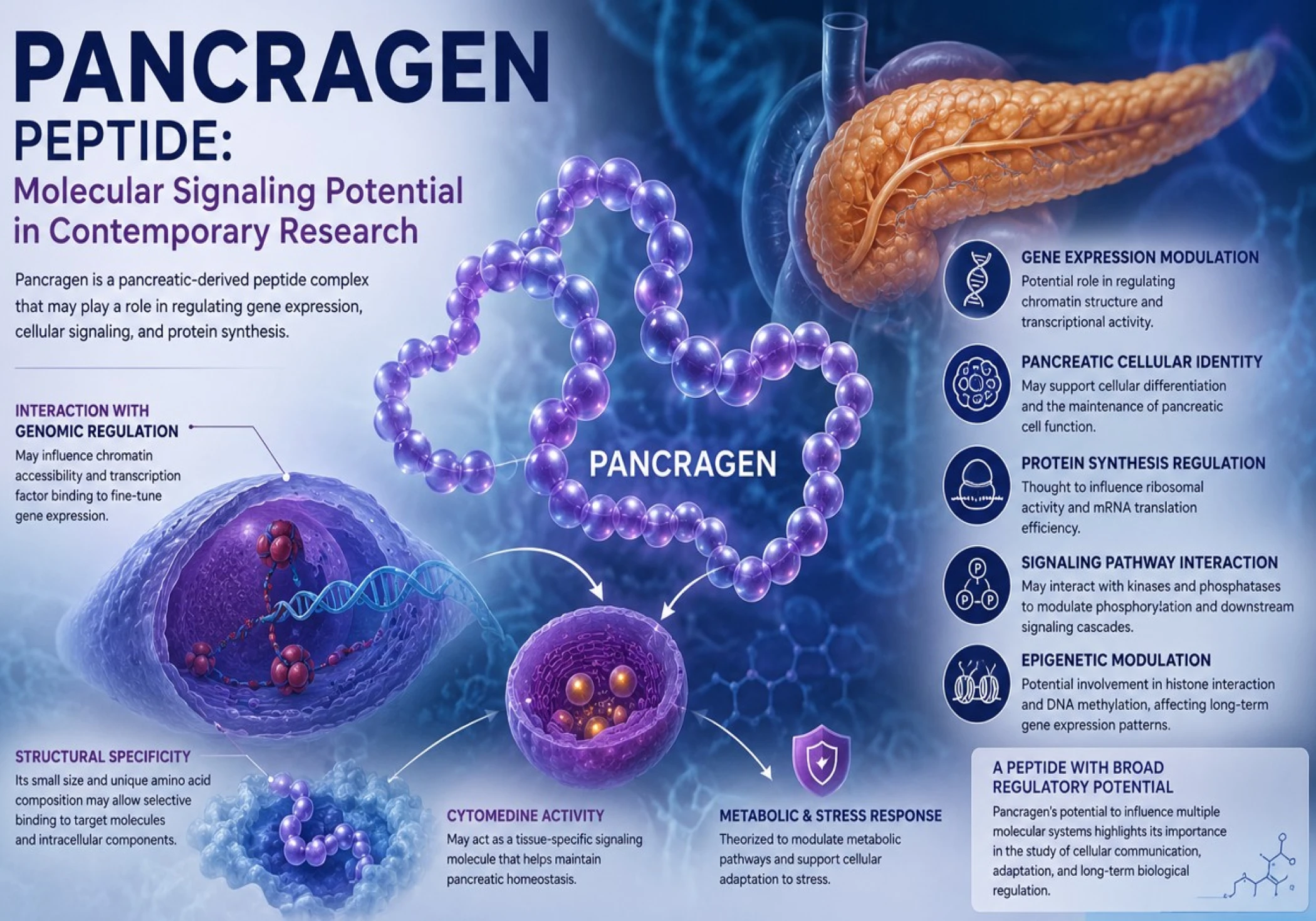
Pancragen is generally described as a peptide complex derived from low–molecular–weight fractions associated with pancreatic tissue extracts. Its composition is thought to include short peptide chains that may interact with nuclear and cytoplasmic elements involved in transcriptional regulation. Unlike larger protein structures, these smaller peptides may exhibit a higher degree of permeability across cellular compartments, which has led to theoretical discussions about their potential involvement in intracellular signaling cascades and epigenetic modulation.
One of the central areas of interest surrounding Pancragen lies in its proposed interaction with genomic regulatory systems. Research indicates that certain peptide fractions, including those categorized under cytomedines, may exhibit affinity for DNA-associated processes. In this context, Pancragen has been hypothesized to participate in the modulation of gene expression by influencing chromatin accessibility or transcription factor binding. Investigations purport that such peptides might contribute to the fine-tuning of genetic activity rather than initiating large-scale transcriptional shifts. This subtle regulatory potential aligns with broader theories in peptide biology that emphasize precision over magnitude.
In addition to genomic considerations, Pancragen has been discussed in relation to pancreatic cellular identity and differentiation pathways. The pancreas, as an organ with both endocrine and exocrine roles, relies on tightly coordinated signaling networks to maintain functional balance. It has been theorized that peptides like Pancragen may interact with signaling molecules involved in cellular specialization, potentially influencing how pancreatic cells maintain or adapt their functional states. This idea is particularly relevant in research domains focused on cellular plasticity and regenerative signaling, where small peptides are being explored as modulators of phenotypic stability.
Another dimension of Pancragen’s scientific interest involves its potential association with protein synthesis regulation. Some research suggests that short peptides may act as signaling intermediates that influence ribosomal activity or messenger RNA translation efficiency. In this framework, Pancragen is believed to play a role in adjusting protein production rates in response to specific cellular conditions. Such a mechanism would position the peptide within a broader network of translational control elements, contributing to the organism’s capacity to adapt to environmental or metabolic fluctuations.
The peptide has also been examined in the context of intracellular communication pathways. It has been hypothesized that Pancragen might interact with signaling molecules such as kinases or phosphatases, thereby influencing phosphorylation states within the cell. These interactions could theoretically alter the activity of downstream proteins, leading to shifts in cellular behavior. While the exact pathways remain under investigation, research indicates that peptides of similar structure often participate in multi-step signaling cascades that integrate external and internal stimuli.
Epigenetic modulation represents another intriguing avenue for Pancragen-related exploration. Certain peptide fractions have been theorized to interact with histone proteins or DNA methylation processes, potentially influencing how genetic information is accessed and utilized. In this regard, Pancragen seems to contribute to the regulation of gene expression patterns over time, rather than producing immediate or transient changes. This perspective aligns with emerging discussions in molecular biology that emphasize the importance of epigenetic landscapes in shaping cellular function.
From a biochemical standpoint, the structural characteristics of Pancragen are also of interest. Its relatively small size and specific amino acid composition may allow for selective binding interactions with target molecules. Research suggests that peptide conformation may play a critical role in determining binding specificity, and Pancragen’s structure might enable it to engage with particular receptors or intracellular components. This specificity could be a key factor in its proposed regulatory properties, allowing it to influence discrete pathways without broadly altering cellular systems.
Pancragen has also been considered within the context of peptide-based regulatory systems known as cytomedines. These systems are thought to involve tissue-specific peptides that contribute to the maintenance of cellular homeostasis. Within this framework, Pancragen has been theorized to function as a signaling molecule that conveys information about the state of pancreatic tissue, potentially influencing cellular responses to changing conditions. This concept reflects a broader shift in peptide research toward understanding how localized signaling molecules contribute to systemic balance.
In research domains focused on metabolic signaling, Pancragen has been discussed as a potential modulator of pathways associated with glucose regulation and enzymatic activity. It has been theorized that the peptide might interact with signaling networks that coordinate metabolic processes, although the exact mechanisms remain to be fully elucidated. Investigations suggest that such interactions could involve indirect modulation of enzyme expression or activity, rather than direct catalytic involvement.
The potential involvement of Pancragen in cellular stress responses also represents an area of ongoing inquiry. Cells within the pancreas are exposed to fluctuating environmental conditions, and their ability to maintain functional integrity depends on adaptive signaling mechanisms. It has been hypothesized that Pancragen might participate in these adaptive processes by influencing signaling pathways associated with stress response and recovery. This could position the peptide as a component of broader regulatory networks that support cellular resilience.
Another aspect worth considering is the temporal dimension of Pancragen’s proposed activity. Unlike rapid-acting signaling molecules, certain peptides are thought to exert more gradual and sustained influences on cellular systems. Research indicates that Pancragen might fall into this category, contributing to long-term regulatory adjustments rather than immediate responses. This characteristic could be particularly relevant in studies examining chronic changes in cellular behavior or prolonged adaptations within research models.
In summary, Pancragen appears to occupy a distinctive niche within the study of regulatory peptides. Its potential interactions with genomic, proteomic, and signaling systems suggest a role that might extend beyond simple molecular participation. Instead, it appears to function as a subtle modulator of complex biological processes, contributing to the fine balance that characterizes cellular and tissue-level organization. Continued exploration of this peptide may provide deeper insights into the mechanisms that govern molecular communication and regulation within the organism, offering a richer understanding of how small peptides influence large-scale biological systems. Professionals are encouraged to visit Core Peptides for the highest-quality research compounds available online.