History has been defined simply as an endless cycle of repetitive patterns. Prior to city dwellings, we grew our own food for survival; in today's world, we have grown vegetables on our rooftops and balconies to pass time. Likewise, prior to mass manufacturing of items through factories, every item was created entirely by hand due to a need for production; in today’s world, creating handmade products is considered a luxury.
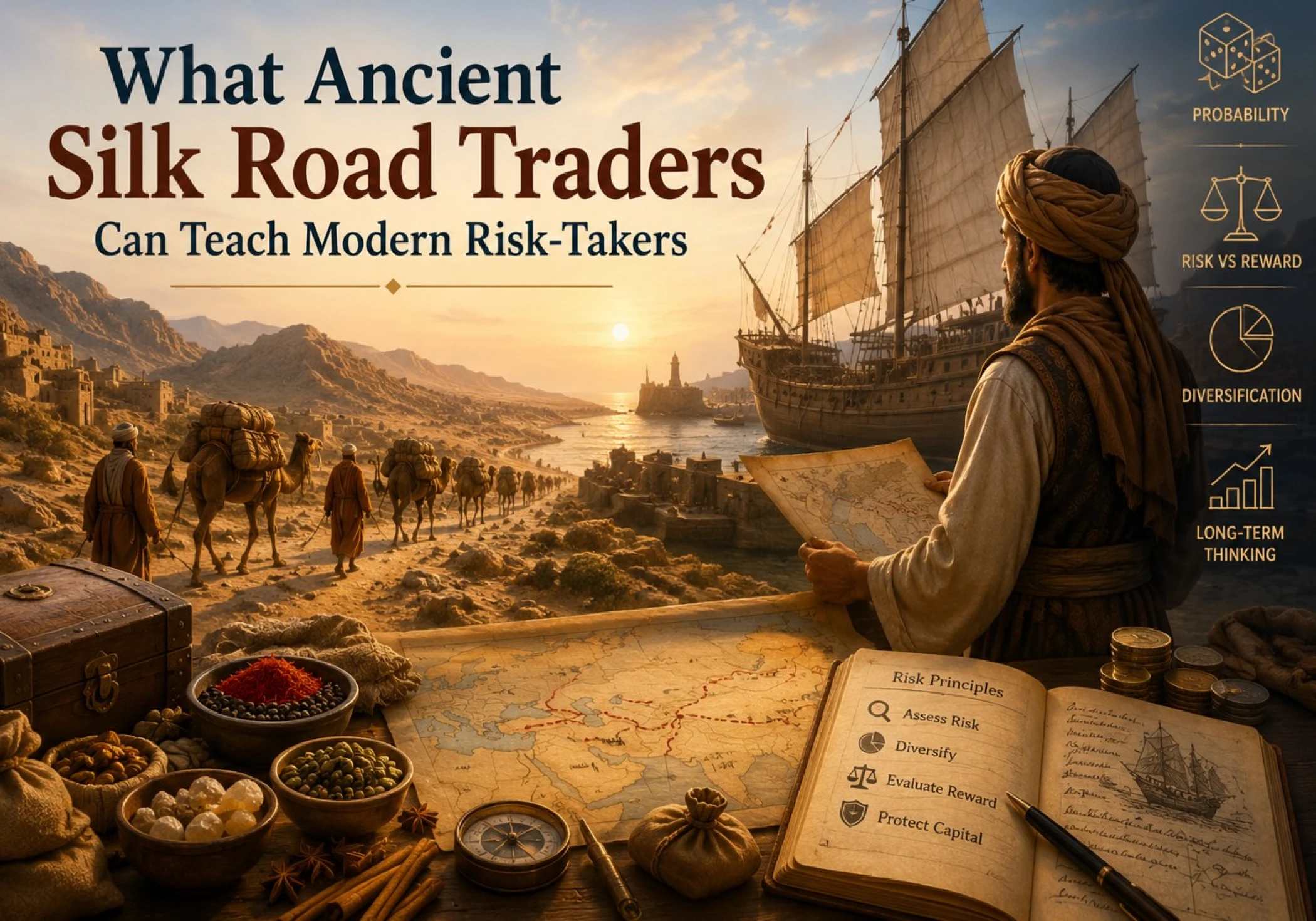
There is a similar cycle in how people deal with risk. Stock markets, betting apps, and business schools existed thousands of years ago. On the Silk Road, ancient traders solved the same problem that traders continue to solve today: determining the potential reward versus the amount of risk involved. These traders didn't call it "probability" or "expected value," but they recognized it in a tangible form. A spice trader preparing his cargo for a boat leaving port had no doubt that the boat may never return. However, he felt confident that the rewards could be substantial if it did arrive.
First Risk Management Tools
Prior to shipping goods over vast distances (such as deserts or seas), these early traders used straightforward methods of assessing risk. What were the odds of being robbed along the route? How frequently do boats sink? How long does the voyage typically take?
These early traders also diversified their risk. Rather than shipping all of their goods in one load on one caravan or one ship, they divided their loads among multiple caravans or ships. Even if one caravan/ship failed, another one may still be successful. Today, this method of spreading risk is still utilized by investors/bettors in the form of diversification.
Luck and Risk Are Not Synonymous Terms
While many individuals today still consider risk synonymous with good fortune/luck, that is not accurate. Risk management involves making informed decisions based upon limited amounts of available data. Thousands of years ago, while ancient traders were aware they couldn’t control factors such as weather conditions, thieves, etc., they were able to exercise control over the amount of risk they incurred on each individual transaction.
Two key considerations were paramount to these early traders:
1) Probability of Success (chance that the risk taken results in a positive outcome)
2) Size of Reward (size of potential gain)
If the potential reward outweighed the risks associated with a particular venture, then even though the venture itself posed significant risks; it was deemed worthwhile. Conversely, if the potential reward was minimal, regardless of whether or not the voyage/risk was low-risk, it may not have been deemed worthwhile to pursue.
Unrealized vs Realized Gains
A major lesson from ancient trade is that profits are not realized until the funds are received. For example, while a cargo vessel carrying goods bound for destination X may contain a large quantity of valuable commodities, the owner/operator of the vessel cannot claim profits until after the vessel arrives safely at its destination and the commodities are successfully unloaded and sold. Until this point, all of which can potentially be disrupted by unforeseen events (storms, etc.), any perceived profit remains theoretical (potential); therefore, this is referred to as an unrealized gain. As soon as the commodities are successfully unloaded and sold, then and only then does the owner/operator receive the actual profit, thus converting an unrealized gain into a realized gain.
Similarly, modern-day gamblers/traders utilize this exact same principle. A favorable position (being up on bets etc.) means absolutely nothing until you close out your positions and withdraw your winnings. Similarly to merchants needing a secure location/port to unload their goods, modern day gamblers/traders require a stable/banking platform to enable withdrawals/cash outs. By comparing different dafabet withdrawal options, users can ensure timely realization of their gains prior to any changes in the market.